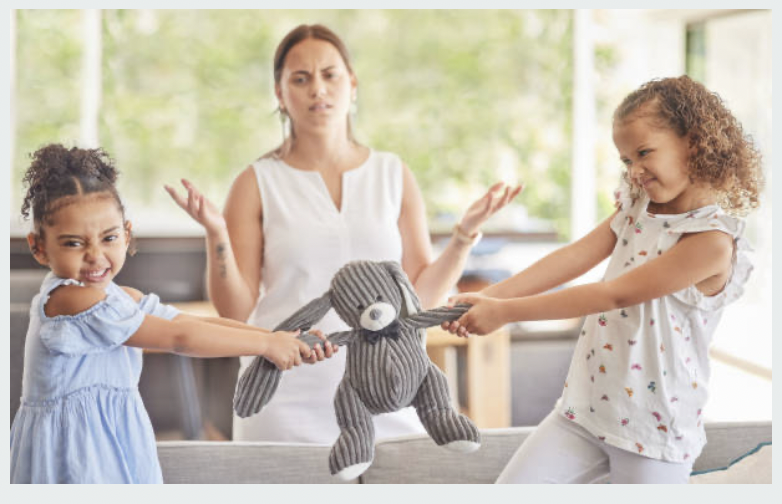
I want you to imagine that your life partner/spouse does something unkind to you. Would you shout “say you're sorry, say you’re sorry” until they tell you they are sorry? If you do this and they say they are sorry, do you think that they are authentically apologetic, or are they trying to get the situation to stop? If this scenario sounds ridiculous to you, why do adults do this with young children?
While I understand the instinct to force children to apologize when their actions harm others, it is important for us, as early childhood educators, to recognize that this action does not “teach” a child to be authentic in making amends. Instead, it teaches the child that there is a quick way out of the situation if they just say two simple words: "I’m sorry."
Young children under 7 are still learning to understand others' perspectives, a skill needed to apologize for their actions. Forcing a child to “say they are sorry” teaches them that it is okay to give insincere apologies- it is also humiliating (NO ONE learns from shame), and they're denied the opportunity to learn empathy. We can support the development of the skills needed to apologize sincerely through a few simple, consistent tools focused on Restorative Practices.
The focus of Restorative Practices is to shift from a focus on “how do we stop this behavior?” to a lens of “what skill is this child missing?” so we can support the development of those skills. Our goal should not be to eliminate conflict from our learning environments, but instead to support children in using the tools needed to repair and restore relationships when conflicts occur. These are skills that will last them a lifetime.
It is essential to note that using these techniques does not negate the child's emotions on the other side of the conflict. It actually puts more focus on how that child can be heard and advocate for their needs. Receiving a forced apology does not make the situation better, nor does it repair any relationship damage.
We need to focus our energy on affective language. Instead of saying:
“That’s not nice,” you can say. “I see you are upset. We can use our hands to push the wall.”
“Stop yelling,” you can say, “your voice is loud right now, which makes it hard for your friends to play. Let’s take a little walk around the classroom and practice turning our volume down.”
If a child grabs a toy from their peer (this is something adults teach children through forced sharing), we can say, “I see you really want the truck, let’s tell your friend you would like a turn when they are finished.” When we focus on the intentional use of language as a means of behavior guidance, we help children recognize their emotions, reflect on how those emotions make them feel, and apply tools to de-escalate the situation.
Instead of a list of teacher-created classroom rules, work as a community to create classroom agreements. These agreements are developed using child-friendly language and visuals. Since the agreements come from the children, they are more likely to incorporate them into their community practices.
Create a space where children can go when they feel overwhelmed. This is a space they would choose to go to, NOT TIMEOUT, that is stocked with calming tools, visuals, and books.
Circle time and/or morning meeting are the perfect times to focus on what it means to be a member of a classroom community. Circle time was created to build community, not as a space to teach rote skills to a large group of children. You can use circle time prompts such as “What can we do if someone feels left out” or “How do we know if a friend is upset” to help children build a community-minded understanding of kindness, inclusivity, and empathy. There are so many amazing books (The Loveliest Books About Friendship & 15 Best Toddler Books About Feelings & Emotions) that can foster authentic discussions and be used alongside the prompts. You can also provide puppets and role-playing scenarios to create engaging learning opportunities.
Young children learn empathy when adults show empathy toward them. Modeling is always the most effective way to present information to a young child. Using phrases such as “I see you are upset, It seems like you are having a tough time or I understand how frustrating it can be…” allows the child to experience empathy. I know there are some people who think that providing empathy is “letting the child get away with” an action or behavior, but affection is not conditional. We don’t withhold empathy and affection when a child exhibits undesirable behavior.
When your students have enough language, you can designate an area for “making things right” rituals. This is sometimes called a Peace Table. This is not a place to force apologies; instead, it is a place where teachers support the children in understanding the situation. The teacher would focus on what happened, how others may have felt, and what can be done to repair the situation. For example, if one child pushes another child, the teacher might say, “Let’s go to the peace table to figure out what happened. I saw you were upset and you pushed your friend, let’s check on them to see if they are okay.” Next, the teacher supports the child as they decide how to repair the situation. Example: get the friend an ice pack, draw a picture for them, help the friend with a task, etc. This practice helps the children develop language they can use on their own and a space where both/all children feel safe and heard.
I know that there are those who will read this and think that when they were a kid or when they were raising their children, they forced the children to apologize or used time-out, etc., and that made them or their children better people. While I understand that we, as humans, can get stuck in a cycle of normalizing things that shouldn't be, that does not mean we shouldn’t learn from the past and make changes in the future. I am 50 years old, and no part of my philosophy on education and parenting hasn’t evolved since I first began my early childhood journey. When we know better, as research on child development shows, it is our responsibility to do better.