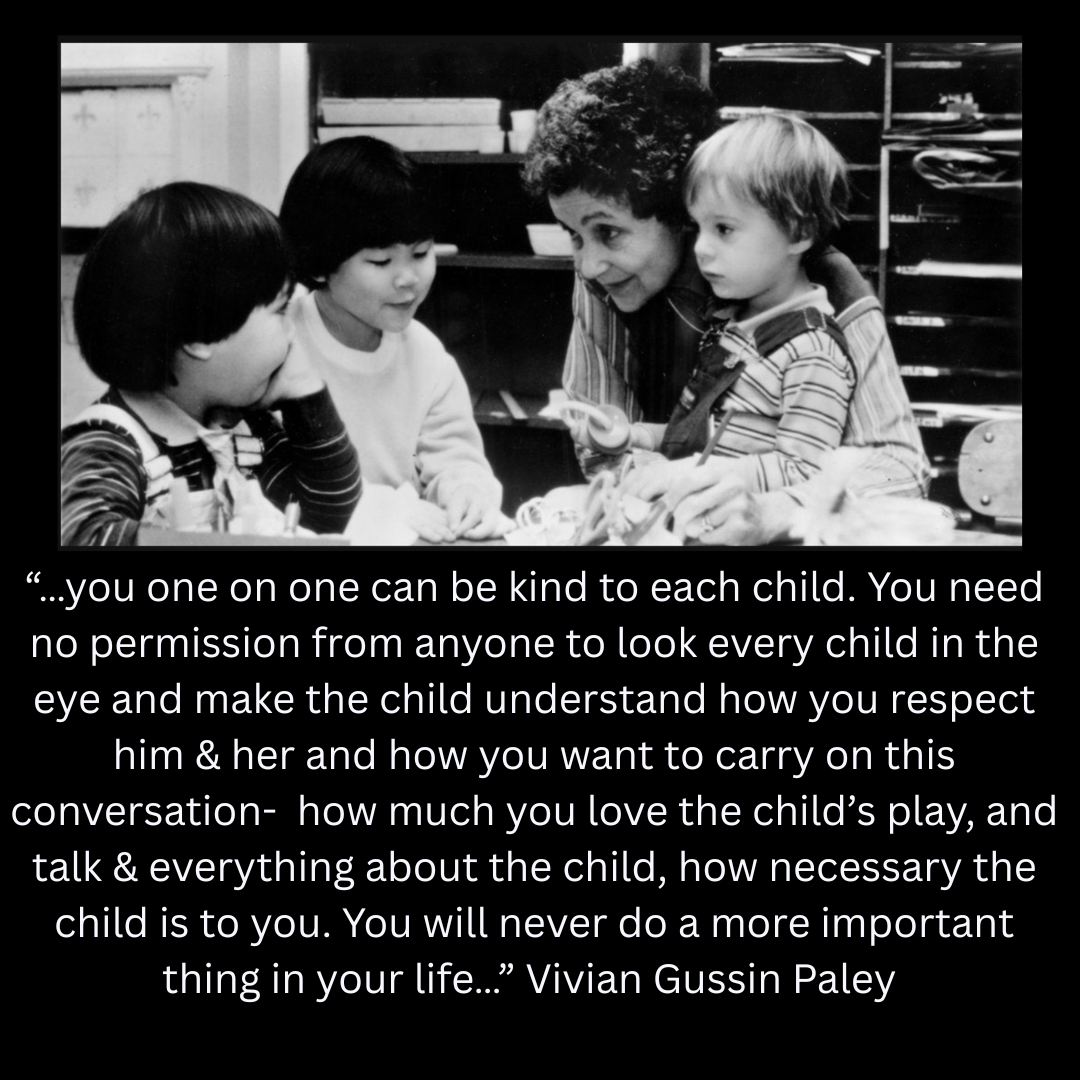
Today, I will be facilitating a parent workshop, for a program in Durham NC, on friendship titled You Can’t Come to My Birthday Party. In preparation for the workshop, I was transported back to the beginning of my career, where one person helped me understand this work we do and why it is important- Vivian Gussin Paley.
At the beginning of my teaching career, I was not a good teacher; I would say I was pretty awful. I didn’t know what to do with a group of children. I worked in a program that did its best to break licensing regulations and be as unsupportive to the teaching staff as possible. I had no idea how poorly the children were being treated- I didn’t know that other programs did things differently. I remember being at my breaking point, searching for jobs outside the ECE field and feeling so lost.
I truly believe that there are times like this when you can be somehow guided to a different direction. This is when I stumbled upon the work of Vivian Gussin Paley in a teaching magazine- the only reason I am still in the field of Early Childhood Education is because of this amazing human.
Vivian Gussin Paley began her work in education in the 1950’s. She dedicated the majority of her professional life to teaching preschool and kindergarten at the University of Chicago Laboratory Schools. Vivian was a proponent of play-based learning in a time when there was a huge shift towards an academic push in the early years classrooms. Her work as a champion of play & storytelling has shaped the work of generations of teacher-researchers.
Vivian Paley’s work focused on the following concepts & theories:
Classroom as a Community: creating inclusive classroom learning environments where all voices are heard, promoting the skill of empathy, and supporting social justice (yep, this is not a new movement, it’s been around forever).
Storytelling & Story Acting Curriculum: children dictate stories to their teacher, who then has their classmates act them out. This practice promotes literacy, social skills, creativity, imagination, turn-taking, problem-solving, and flexible thinking. (This is something I did with children of all ages as a family childcare provider, toddler teacher and preschool teacher)
Fantasy (Imaginative) Play: Essential for cognitive, social, and emotional development. This type of play allows children to make sense of the world around them.
The first book I read by Vivian Gussin Paley was You Can’t Say You Can’t Play. The insights in this book helped me understand early friendship dynamics and provided the information I needed to support peer relationships in my classroom.
The next book I read was In Mrs. Tully's Room: A Childcare Portrait. This book helped me understand the importance of nurturing connections with the children in my care while also exploring storytelling.
I also enjoyed reading and learning from The Boy Who Would Be a Helicopter, which taught me to value children for who they are and to support them in becoming valued members of the classroom community.