

First Hour Needs
I feel privileged to build lasting relationships with early childhood programs (& early childhood educators). I am currently co-learning with a program in Massachusetts- I truly enjoy learning alongside those I serve.
During my many conversations with the program leaders, I’ve heard the term “first hour needs” being mentioned. Although I understood what the term meant in the context of the conversation, I am a natural researcher, so I am always looking to dig deeper into a topic. After learning more about First Hour Needs, I knew I had to share this information with all of you.
In L. Tobin’s book, What Do You Do With A Child Like This?, he shares a definition and framework for this theory. Each human, young and old, has needs that must be met in the first hour of each day. Adults, for the most part, can delay some of those needs, while children, especially those with stressful home situations, can not.
What does this have to do with us, since we are not with the children when they wake up? It has everything to do with us, as we are co-caregivers. We need to ensure that when a child walks into our learning environments, they feel safe, nurtured, and connected to trusted caregivers.
It can be difficult to determine each child's unmet needs, but we can develop a framework of “needs to be met” for each young child in our care. I’ve used L. Tobin’s book as a resource to create a framework designed for our youngest learners. The quotes are directly from the book, and the rest of the information is my interpretation of his work and my understanding of the development of secure attachments.
The Need for Touch:
“Touch is the clearest and most direct communication between two people. Perhaps that’s why we are never too young or too old to enjoy it and why words will never replace it.”
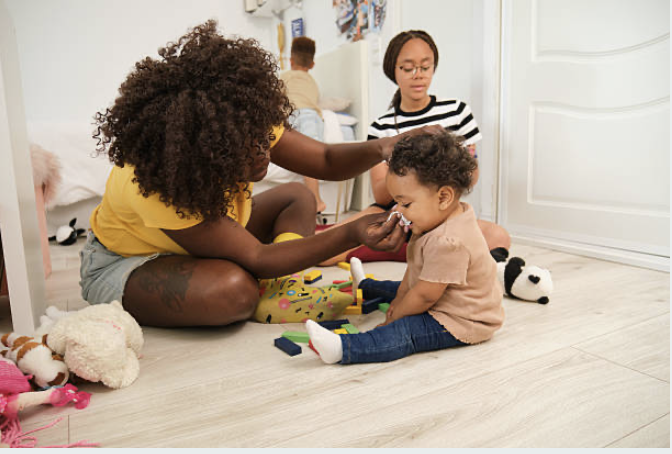
I believe that the need for touch goes hand in hand with our morning greeting when the children arrive. Take the time to pause, acknowledge, and greet each child and their family when they arrive in the morning. This should also include some type of touch- a hand on the shoulder, a high five, a hug, etc, whatever the child is comfortable with, as we want to honor their autonomy and agency.
The Need for Communication & The Need for Acknowledgement:
“Children with home problems come to school emotionally loaded. The earlier you deal with it, the better” & “Being acknowledged by someone, welcome into the world each morning, is important to a child’s good breakfast.”
When children arrive in the morning, we don’t want to overwhelm them by talking at them; instead, we want to talk with them (serve-and-return interactions). The main thing we want to remember is that children need to be heard- we need to practice listening to understand and not just listening to respond. Pause, be present, have wait time, and acknowledge the words (and emotions) of the children as they arrive each morning.
The Need for Socialization & The Need for Relaxation:
“Ultimately, the child’s personal and job success as an adult will be determined more by an ability to get along with others than by specific skills,” & “Relaxation is a direct route to enhanced learning, creative problem solving, anger management, stress management, and general health.”
When children arrive in the morning, they need the opportunity for a relaxed entrance and a few choices for socializing with their peers (not forced activities). Encourage the children to practice deep breathing techniques while washing their hands in the morning. Set up two spaces with materials for the children to explore, and one space where the children can just sit and be.
The Need for Humor:
“Humor heals”
I am someone who takes myself way too seriously- which makes for a stressful and often boring existence. The only time I don’t take myself too seriously is when I am in the company of a group of children. I find young children to be the most hilarious humans. They do and say the most interesting things, and they really enjoy making adults laugh. It’s important that we experience the joy of laughter and make time for humor throughout the day in our classrooms. Life is way too short to be so serious all the time. Our youngest learners need spaces where they can spend time telling the most ridiculous knock-knock jokes and laughing every time they hear the word “underwear”.
The Need for Structure:
“For many children, school is the one constant in their life, the one structure they can depend upon.”
In our early childhood classrooms, structure does not equal standardization; instead, it equals consistent routines. The children and their families should know the routine for entering the classroom each morning. Schedules and routines are two different things. The schedule is the time of day things happen, which is not a concern to young children. Routines are the steps that we follow to move from place to place in the classroom- routines should be three steps, no more and no less. One example of a routine is: when a child arrives in the morning, they place their belongings in their cubby, say goodbye to their parent/guardian, and then wash their hands. A consistent routine becomes muscle memory, and eventually the child goes through it without needing to stop and think.
The Need for Encouragement:
“The child who needs encouragement may seek constant reassurance. If she is afraid of failure, she may say I can’t and avoid trying. If she becomes discouraged by failure, she will say, I won’t, and refuse to try.”
Find times throughout the day to help a child through their frustrations. When a child says “I can’t,” you can use a growth mindset technique and add the word yet to their statement- “I can’t yet”. Take time to learn what makes the child laugh, what makes them sad, who they love the most, what their favorite book is, and what their favorite part of the school day is.
The Need for Nourishment:
“There is no remedy for a child’s hunger other than to provide food. Somewhere, somehow, the child must be fed.”
There is nothing that makes me angrier than when certain people go on and on about the fact that it is the responsibility of their parents to feed children. Let’s be clear, there is NO SUCH THING as other people's children. We, as a human race, should ensure that no child is hungry. It isn’t about being “fair or unfair,” it is about food being a right, not a privilege. If a child in your care is hungry, feed them!
The Need for Physical Activity:
“All vertebrates stretch to begin the day. Tension flows out of active muscles. All bodies need activity and oxygen to stay awake, and with kids, all you need to do is provide the occasion.”
Young children should be able to move their bodies throughout the day. There is no need for “sitting still or criss-cross applesauce”. Children learn by doing. The construct knowledge through movement.
